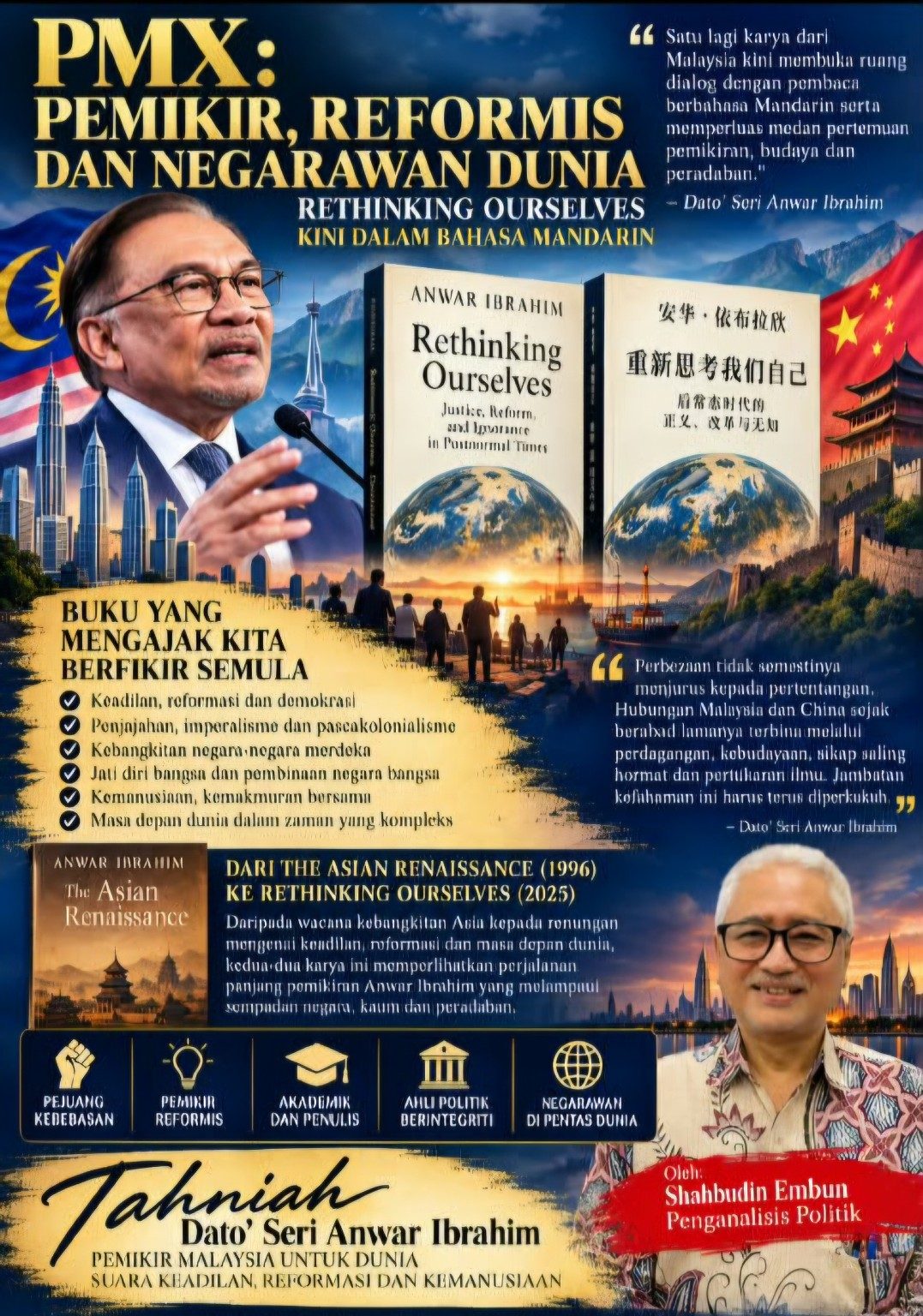
I was deeply moved to see the work of Datuk Seri Anwar Ibrahim, Rethinking Ourselves: Justice, Reform, and Ignorance in Postnormal Times, now officially available in a Mandarin translation.
To me, this is not merely another translation of a book.
It carries a much greater significance — the ideas of a Malaysian statesman are now entering into dialogue with Mandarin-speaking readers and communities, particularly within the broader context of Malaysia-China relations and the wider discourse on civilisation. Bernama reported that Anwar himself views this initiative as a platform for the meeting and exchange of ideas, cultures and civilisations.
I see Rethinking Ourselves as a continuation of Anwar Ibrahim's long intellectual journey.
This book is not simply a memoir or autobiography. It invites readers to reconsider much larger questions — justice, reform, colonialism and imperialism, nation-building, identity, democracy, humanity and the future of the world in an increasingly complex era. The publisher itself describes the book as an effort to rethink how humanity should adapt to rapid change and shape a fairer and more sustainable future.
FROM “THE ASIAN RENAISSANCE” TO “RETHINKING OURSELVES”
I still remember The Asian Renaissance, written by Anwar Ibrahim when I myself was still in college.
Published in 1996, when he was Deputy Prime Minister and Minister of Finance, the book explored, among other subjects, East-West relations, democracy and civil society, justice and the rule of law, culture, Islam in Southeast Asia, and the future of Asia.
Almost three decades later, we can see an interesting continuity.
The Asian Renaissance spoke about the revival of Asian thought and civilisation.
Rethinking Ourselves, meanwhile, invites humanity to reconsider ourselves, our societies and our world in an era of rapid, uncertain and challenging change.
To me, both works reveal a common thread: the need to think beyond the boundaries of nation, race, culture and geography.
More interestingly, The Asian Renaissance itself has now been translated into Mandarin. A work written three decades ago has once again found a place within China's contemporary intellectual discourse.
FROM ACTIVISM TO THE DISCOURSE OF STATESMANSHIP
The journey of Anwar Ibrahim cannot be understood solely through the political positions he has held.
It can also be understood through his ideas and writings.
From student activism and social struggles, to debates on justice, democracy, reform and civil society, that journey eventually brought him to the highest office of government as Prime Minister of Malaysia.
In Rethinking Ourselves, his political and personal experiences become part of a broader reflection on justice, democracy, postcolonialism and the global order.
That is why I see him through several interconnected dimensions:
activist, reformist, writer, thinker, politician and, ultimately, statesman.
Each role has its own historical context. What is particularly interesting, however, is how these experiences have been translated into ideas about the state, society and humanity.
BEYOND THE EAST-WEST DICHOTOMY
One of the most interesting aspects of Anwar's thinking is his tendency not to view the world simply through the lens of an East-versus-West divide.
He connects the Islamic intellectual tradition with the broader heritage of world thought.
In his remarks concerning the Mandarin edition of Rethinking Ourselves, Anwar himself referred to the traditions of Confucius and Mencius, Shakespeare, and various intellectual treasures of different civilisations as sources of wisdom capable of enriching humanity.
This, to me, is where the work carries particular significance.
We do not necessarily have to choose between East and West.
Instead, we can draw wisdom from different civilisations in search of common ground on matters that are more fundamental — justice, truth, compassion, respect and human dignity.
DIPLOMACY THROUGH THOUGHT
In the context of Malaysia-China relations today, the publication of this Mandarin edition also carries an interesting dimension.
Relations between nations are not built solely through trade, investment and official diplomacy.
They can also be strengthened through books, knowledge, culture and the exchange of ideas.
When a work from Malaysia is translated for Mandarin-speaking readers, it creates another avenue for people to understand how a Malaysian leader views questions of the world, justice, development and humanity's future.
In my view, this represents a more subtle form of diplomacy — diplomacy through knowledge and ideas.
A JOURNEY THAT CONTINUES
I do not see Rethinking Ourselves as the conclusion of Anwar Ibrahim's intellectual journey.
Rather, it can be seen as another chapter in an intellectual journey that began several decades ago.
From The Asian Renaissance in 1996, to Rethinking Ourselves in 2025, and now to its Mandarin translation in 2026, we can see how ideas written in one era can be revisited and interpreted in another.
And perhaps that is where the true value of an intellectual work lies.
It is not merely what its author wrote in his own time, but what subsequent generations are still able to think about, question and discover through it.
As a Malaysian who has followed Anwar Ibrahim's political and intellectual journey for many years, I extend my congratulations to Datuk Seri Anwar Ibrahim on the official publication of the Mandarin edition of Rethinking Ourselves: Justice, Reform, and Ignorance in Postnormal Times.
From the struggle for reform to national leadership, from the political arena to academic and intellectual discourse, his journey forms part of the history of modern Malaysian politics and thought — a history that deserves to be studied, debated and examined by generations to come.
Congratulations, Datuk Seri.
May more intellectual works from Malaysia cross the boundaries of language, culture and geography — becoming bridges between peoples and civilisations.